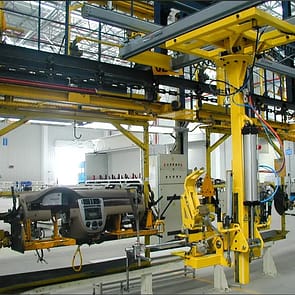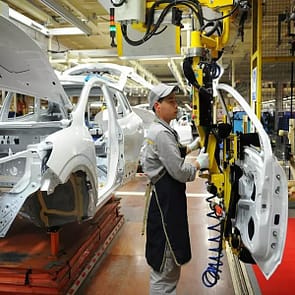
Assisted manipulator arms act as “force multipliers” and “precision assistants” in automotive assembly workshops. Because automotive assembly involves a large number of heavy, irregularly shaped parts with high installation precision requirements, relying solely on human labor or fully automated robots often fails to balance flexibility and cost. Assisted robotic arms thus provide the optimal balance.
The following are the main roles of assisted manipulator arms in automotive assembly workshops:
1. Reducing Labor Intensity and Improving Ergonomics
This is the core function of assisted manipulator arms. Many parts on the assembly line (such as seats, dashboards, and tires) weigh more than the physiological limits of a single person’s continuous handling.
Gravity-Free Operation: Through pneumatic or electric balancing, workpieces weighing tens or even hundreds of kilograms are placed in a “floating state,” requiring only minimal force (usually less than 2 kg) to move them.
Prevention of Occupational Diseases: It reduces chronic back and shoulder injuries caused by prolonged bending and lifting heavy objects, meeting the requirements of modern factories for employee welfare.
2. Achieving High-Precision Positioning and Assisted Assembly
During final assembly, many parts require precise alignment within the confined space of the vehicle body.
Smooth Movement: The manipulator arm, with its multi-joint degrees of freedom, ensures the workpiece remains stable during movement. Combined with specialized grippers, millimeter-level assembly accuracy can be achieved.
Complex Posture Adjustment: It assists workers in flipping, tilting, or rotating workpieces. For example, when installing a dashboard, it needs to be tilted into the cabin and then leveled to align bolt holes; the manipulator arm can easily perform these actions.
3. Protecting Workpiece Quality and Preventing Collisions
Automotive exterior and interior parts are extremely delicate; collisions can lead to parts being scrapped or requiring rework.
Collision-Proof Design: The robotic arm is equipped with safety protection devices (such as a self-locking function). Even in the event of a sudden gas or power outage, the workpiece will lock in place and not fall.
Precise Grip: Customized grippers (such as vacuum suction cups or soft-coated claws) firmly grasp the workpiece, avoiding slippage, fingernail scratches, or hand sweat contamination that can occur during manual handling.
4. Key Application Scenarios Overview
Seats: Heavy (30-50kg), confined space; manipulator arms can quickly grasp, smoothly deliver into the vehicle, and precisely align with the rails.
Dashboards: Complex shape, easily damaged; manipulator arms can assist in tilting and supporting weight for bolt fixing.
Glass: Fragile, large area, requires adhesive; manipulator arms, in conjunction with vacuum suction cups, adhere precisely to the window frame.
Doors: Heavy, require precise alignment with hinges; manipulator arms can reduce weight burden and assist in hinge pin alignment.
Tires: High repetition frequency, difficult bolt hole alignment; manipulator arms can reduce labor frequency and assist in rotating and aligning wheel hub bolt holes.
Spare Tires and Batteries: Deep space, awkward handling posture; manipulator arms reach into the trunk or chassis area for precise placement.
5. Improved Production Cycle Time and Flexibility
Increased Efficiency: Heavy items that previously required two workers to move can now be easily and quickly handled by a single worker using robotic arms, significantly shortening the cycle time per workstation.
Flexible Adaptability: The same robotic arm can adapt to mixed-line production of different vehicle models by changing the end effector or adjusting the program, meeting the flexible manufacturing needs of modern factories.
Assisted manipulator arms are key equipment for achieving semi-automation in the final assembly workshop, combining human judgment with mechanical strength. With the widespread adoption of electric vehicles, the importance of assisted robotic arms is becoming increasingly prominent, especially given the heavier battery packs and highly integrated chassis modules.